
AI: from dead end to living beginning
Can intelligence be intelligently designed? Can it evolve with machines?

Content
1 - Engineering AI: Deductive reasoning and programming
2 - Evolving AI: Inductive learning and compression
2.1 - Computers are universal machines.
2.2 - Universal machines are unpredictable.
2.3 - Unpredictable machines can be intelligent.
3 - Evolving intelligent designs
The religious idea of intelligent design suggests that God created life to fulfill his goals and purposes.
The scientific theory of evolution says that life evolves through natural selection, with no goals or purposes.
The conceptual divide between purposeful design and spontaneous evolution splits not only our stories about life but also the history of AI. This article tries to dive under the divide:

The dive takes us back to deeper roots of AI, which shed light on its past, resolve some of the present misunderstandings, and anticipate its future.
1 - Engineering AI: Deductive reasoning and programming
The usual story of the origin of AI says that artificial intelligence was invented at the Dartmouth College workshop in the summer of 19561. Here is a picture of the participants and a copy of the invitation sent to Ray Solomonoff [9].
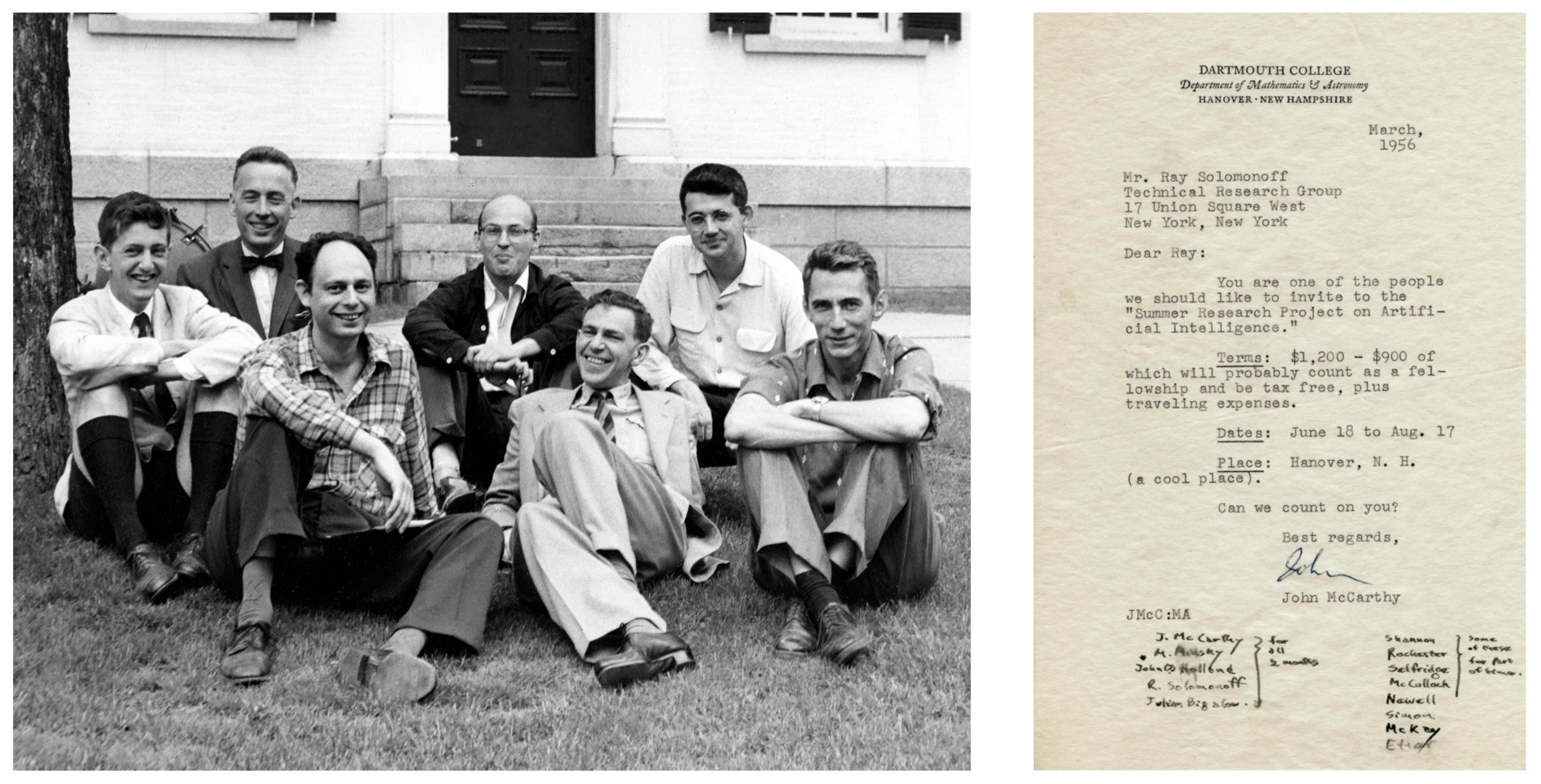
Seated in the front row right is the great Claude Shannon, just 40 at the time, but already a world star, as the originator of information theory [7]. Behind him is John McCarthy, the workshop organizer and the godfather of the term “artificial intelligence”. Ray Solomonoff is the guy with worn shoes, in the front row left. A couple of years after this picture was taken, he originated algorithmic information theory [10], which, however, only attracted due attention after the great Andrey Kolmogorov cleared a path to it from a different direction. Most big ideas tumble like that, including the idea of AI.
At the time of the Dartmouth Workshop, the idea of artificial intelligence was in the air, spreading most notably from Alan Turing’s seminal paper [12] on “Computing Machinery and Intelligence”, which appeared in the philosophical journal “Mind” (henceforth called the Mind paper). The paper kicked off with:
I propose to consider the question: `Can machines think?’
Towards the answer, Turing contributed what we now call the Turing Test. The underlying idea was that a machine should be considered intelligent if a tester, interrogating the machine in parallel with a human through an arbitrary sequence of written messages, remains unable to tell who is who. The idea left an impression on Shannon and he arranged to travel to Manchester to talk to Turing, during the break after a public lecture for which he was invited to London in 1951. For Turing, though, his Mind paper was a non-technical farewell to the project of building a stored-program computer for the purpose of investigating machine intelligence, for which he had accepted a position at the National Physical Laboratory. As the project hit a series of administrative snags [2, Ch. 6], Turing moved to Manchester and ended his life a couple of years later [2, Ch. 8]. By the time of the Dartmouth Workshop, Turing’s ideas had faded. In the volume on “Automata Studies” [8], which Shannon and McCarthy edited just before the workshop, they objected that
a disadvantage of the Turing definition of [intelligence] is that it is possible, in principle, to design a machine with a complete set of arbitrarily chosen responses to all possible input stimuli […] With a suitable dictionary such a machine would surely satisfy Turing’s definition.
The obvious disadvantage of the objection is that Turing’s tests are of unbounded length and storing “a complete set of arbitrarily chosen responses to all possible input stimuli” would require infinite memory. But that “detail” was overshadowed by the need for a fresh start, to catch the winds of software and hardware engineering, which was the stated objective of the workshop. That is why a new name was sought, and artificial intelligence (AI) was found. Artificial intelligence was construed as software, to be designed by intelligent designers, whereas Turing thought of machine intelligence as a new paradigm of computation and epistemology that would evolve with computers.
2 - Evolving AI: Inductive learning and compression
The usual story of the origin of computers goes back to the XVII century logical calculator envisioned by Gottfried Leibniz and to the XIX century analytic calculator built by Charles Babbage and programmed by Lady Ada Lovelace. But the world of computers and networks around us grew from the ideas and constructions of Alan Turing, who lived from 1912 until 1954. The paradigm shift from early calculators to modern computers can be presented by contrasting two slogans:
Lovelace: A [programmable calculator] has no pretensions whatsoever to originate anything. It can do what we know how to order it to do.
Turing: We cannot generally know what we programmed a computer to do by reading the programs. We can only know what we ordered it to do if it does it2.
While Lovelace’s claim was an opinion, informed by the experience of programming Babbage’s analytical engine, Turing’s claim was a logical consequence of the theorem proved in his breakthrough paper [11]. Most importantly, Turing’s constructions of limits of what we can know gave rise to the methods to expand what computers can do. They can behave in ways that we cannot predict. Turing’s result in his Decision paper [11] was not just a negative solution of Hilbert’s Decision Problem (a.k.a. the Entscheidungsproblem), but also a fulcrum (pivot point) for an Archimedean “lever to move the world” — this time the world of computation. It wasn’t just the end of Hilbert’s slogan that “there is no ignorabimus3 in natural science” [1], but also the beginning of the sciences studying the bounds of information processing: the theories of computability and complexity, of information and coding, and of algorithmic information and inductive learning. Their common denominator is that they are all leveraged against provable ignorance. Turing’s results in that direction evolved through three insights:
1) computers are universal machines,
2) universal machines are generally unpredictable, and
3) unpredictable machines allow intelligence.
Insights (1) and (2) emerged in the epochal Decision paper [11], which made the 24-year-old Alan Turing famous in spite of his apparent lack of social and political skills. Discovery (3) took the rest of Turing’s life, and in a figurative sense, it even took his life before his 42nd birthday. Each of Turing’s discoveries packs significant mathematical, logical, and epistemological content. I will attempt to provide non-technical but hopefully informative accounts in the forthcoming articles. Here I attempt to provide a bird’s eye view of insights (1-3).
2.1 - Computers are universal machines.
Machines perform functions. Functions map inputs to outputs. To display the inputs and the outputs of machines, we draw them in boxes, like this:
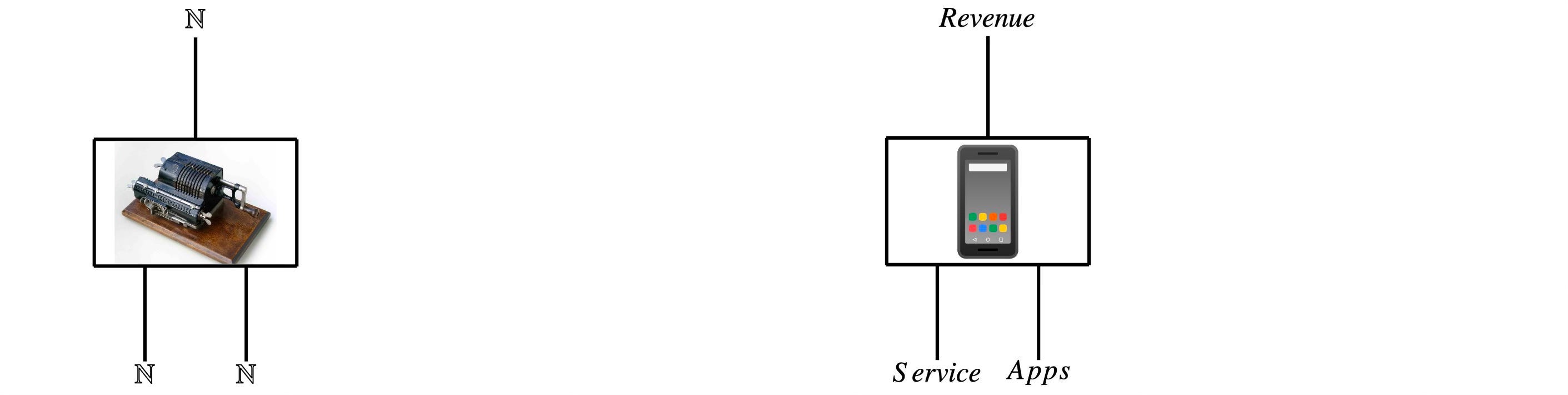
The inputs flow in at the bottom, the outputs flow out at the top. A calculator inputs pairs of numbers and outputs, say, their sums or products. A phone inputs the service connection and the apps and outputs the revenue for the service and the app providers. We could also have here a washing machine, which inputs detergent and dirty laundry and outputs clean laundry. For every function we build a different machine.
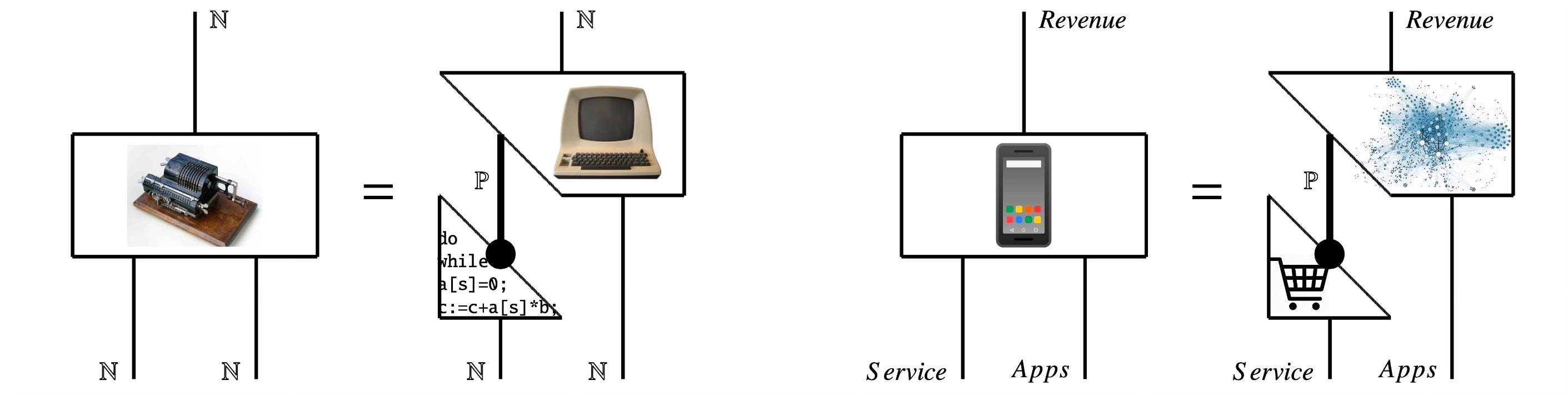
Universal machines can be programmed to perform everything that all other machines from their family can do. While a calculator can calculate only the arithmetic operations that it was built to calculate, a computer can be programmed to calculate any computable data operation. While every phone provides revenue to a particular service provider and to the developers of the particular apps installed on it, the network serves all phones, and all service and app providers. This is illustrated in the following diagrams [6], saying that the input-output relations on the two sides of each equation are the same.
While there are no universal household machines, that could perform all functions of washing, cooking, vacuuming, etc., a smart household can be viewed as a programmable, extensible, and therefore universal machine.
In [11], Turing presented a mathematical model, nowadays called a Turing machine, such that any mathematically computable function can be performed by such a machine. A diagram of a Turing machine for multiplying binary numbers4 is in the box on the left.
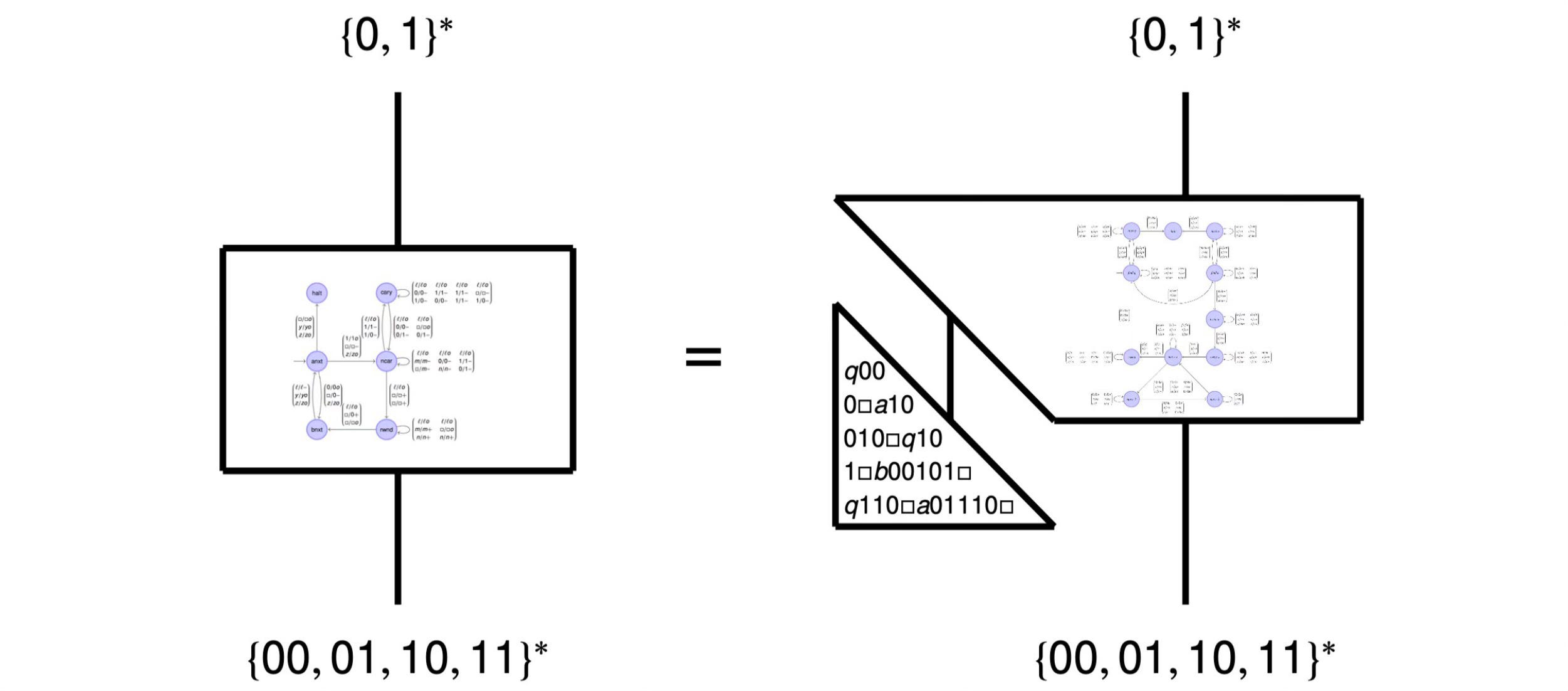
The trapezoid on the right contains a diagram of a universal Turing machine5. The triangle on the right shows a fragment of a program describing the multiplication machine on the left. The universal machine executes the program to compute the function of the particular machine on the left. This is the general schema of computation in universal machines [6].
2.2 - Universal machines are unpredictable.
The universality of a machine u means that
for every machine f there is a program F such that uF(x)=f(x), for every input x.
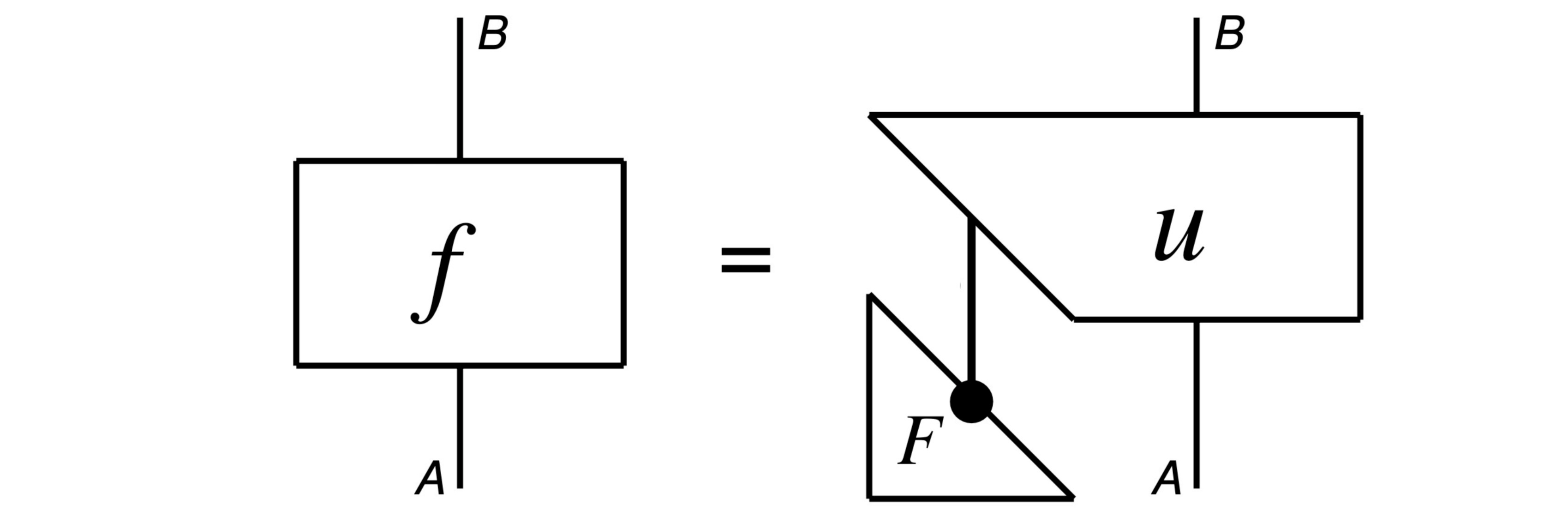
In particular, if we instantiate the function f to be f(x)=ux(x), then the corresponding program F for f can be instantiated to U so that uU(x)=ux(x). In other words, executing the program U on input x produces the output of executing x as a program on itself.
Now if computations are performed on bitstrings, as in our computers, then for every function f, there is also a function ¬f, where the negation ¬ is defined on the bits by ¬0=1 and ¬1=0. So every output bit of ¬f is different from the corresponding bit of f. If we define f by setting f(x)=¬ux(x), then there is a program which we can conveniently call¬U, such that u¬U(x)=¬ux(x). Evaluating ¬U on itself gives the computation
u¬U(¬U)=¬u¬U(¬U)
Since every output bit of u¬U(¬U) would thus have to be different from itself, this computation cannot produce any outputs. It can be thought of as an infinite loop and we write it as ↻ = u¬U(¬U).
So for any computer u, there are programs like ¬U which do not halt. Can we predict whether a given program P will halt on an input x? Such predictions would give a halting function h such that
h(P,x)=1 if the computation uP(x) halts and
h(P,x)=0 if it does not halt.
Like before, there is a program H such that uH(P,x)=h(P,x). But now we can use H to derive a program K for the function k defined by
k(P,x)=↻ if h(P,x)=1 and
k(P,x)=1 if h(P,x)=0.
The problem with K is that, when run on itself, it can neither halt nor not halt:
If k(K,x) halts, then the halting function h has the value h(K,x)=1 and therefore k(K,x)=↻, which means that k(K,x) does not halt.
If k(K,x) does not halt, then the halting function h has the value h(K,x)=0 and therefore k(K,x)=1, which means that k(K,x) halts.
Either way, the existence of K leads to a contradiction. Therefore K cannot exist, which implies that H cannot exist either, since K could be constructed from it. So the function h, predicting whether any given program P halts, cannot be programmed. This was the main result of [11]6. It was later strengthened to show that the only computational properties that can always be decided7 on programs are the two trivial ones: the one satisfied by all computations, and the other by none [6, Ch. 5.4]. In other words, machines are unable to predict their own behaviors by analyzing their programs internally, but can only observe their behaviors externally. They are incapable of introspection.
2.3 - Unpredictable machines can be intelligent.
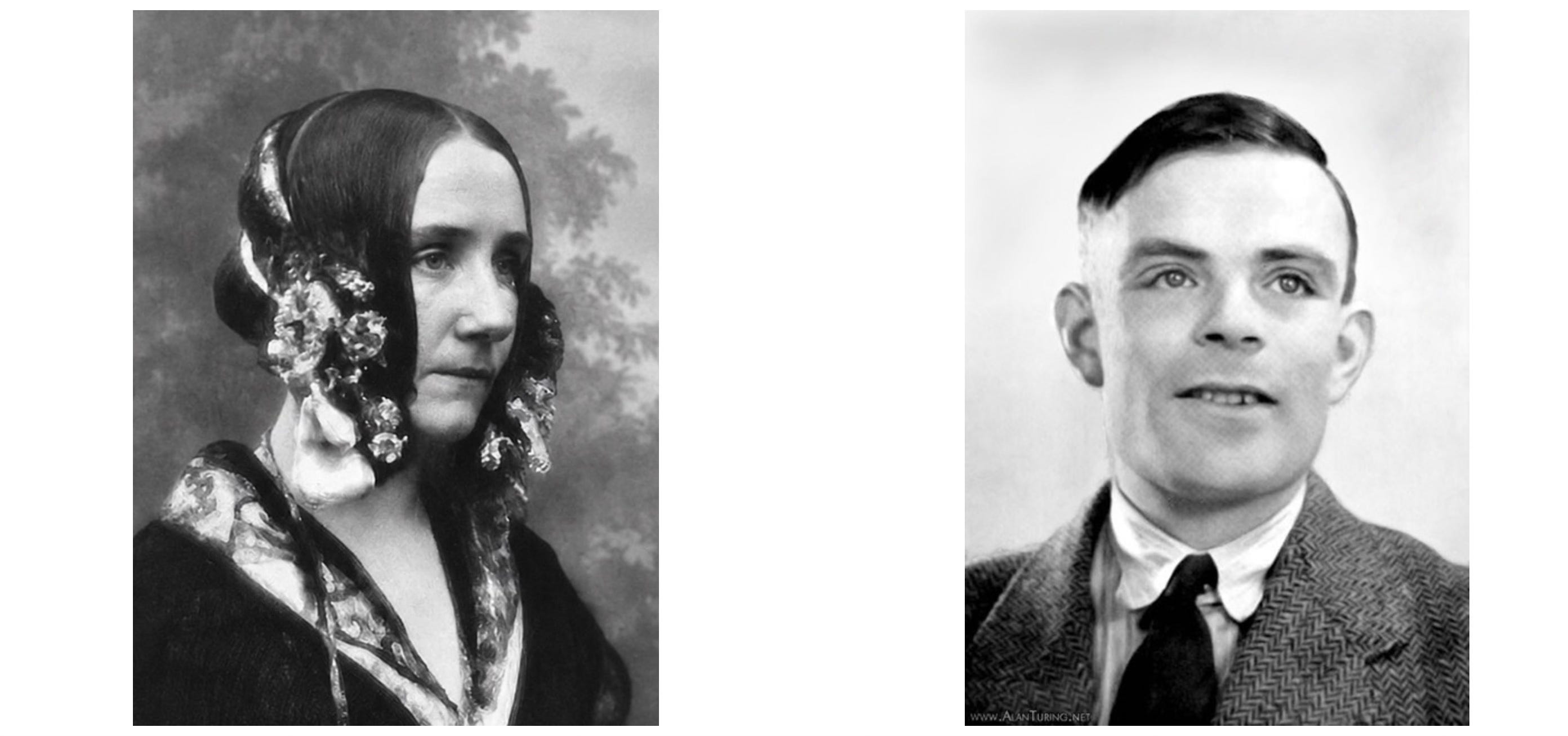
At the beginning of his career, in the Decision paper of 1936 [11], Turing developed his machine as a precise mathematical model of computers and proved its universality and undecidability. Close to the other end of his career, in his Mind paper of 1950 [13], he discussed the idea of intelligent machines. Both papers were widely read and carefully studied. The closest that he got to a precise mathematical model of intelligent machines was in the 1948 technical memo [12], which remained largely unknown for a long time, and is still seldom read. It was written on request of Turing’s supervisor at the National Physical Laboratory (NPL), Sir Charles Galton Darwin, the grandson of the originator of the theory of evolution, the great Charles Darwin. Sir Darwin’s photo is on the left, with a picture of Turing from the NPL period on the right.
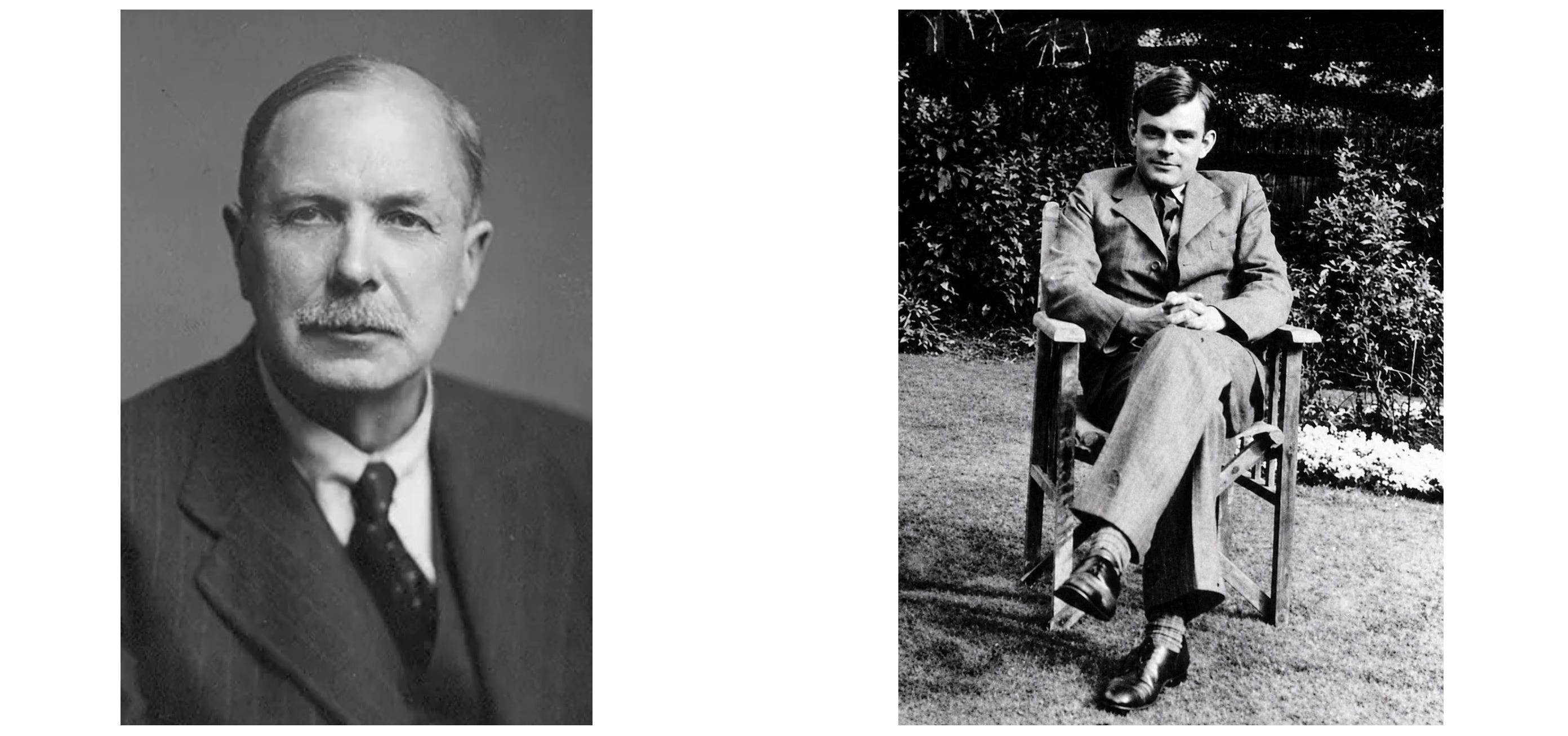
Sir Darwin was a solid civil servant and managed the NPL to the best of his abilities. He read Turing’s submission as carefully as he could, and noted in the minutes from a meeting of the Executive Board of the NPL that it read “as a schoolboy’s essay”. He also repeatedly objected that Turing was “unkempt”. The memo got shelved and remained largely unknown until a reconstructed text appeared as [12]. The crux of Turing’s concept of machine learning is the distinction between
“organised machines” that can be programmed by programmers, and
“unorganised machines” that can learn from teachers and supervisors.
The former roughly corresponds to Turing machines; the latter to what we would call Boolean neural networks. From a logical standpoint, the former machines capture the deductive procedures, whereas the latter provide an effective model of inductive learning. While the deductive procedures are studied in computer science, with Turing’s organized machines as a central tool, inductive learning was a logical problem in Turing’s time, remained a logical problem long after, and Turing’s unorganized machines, as a model of machine learning, remain largely unknown. While the technical comparison of Turing’s neural networks with the modern ones (and his universality claim!) have to be left for another occasion, already his nontechnical remarks from nearly 80 years ago, from the final section of [13], may dispel some of our current misunderstandings:
An important feature of a learning machine is that its teacher will often be very largely ignorant of quite what is going on inside. […]
This is in clear contrast with a normal procedure when using a machine to do computations: one’s object is then to have a clear mental picture of the state of the machine at each moment in the computation. This object can only be achieved with a struggle.
[Lady Lovelace’s] view that “the machine can only do what we know how to order it to do”, appears strange in the face of this fact. Intelligent behaviour presumably consists in a departure from the completely disciplined behaviour.
There are thus two paths to computation. When we program organized computers, our goal is to determine what they will do. When unorganized computers organize themselves through learning, we can never completely determine what they will do. There are infinitely many programs for every computation, but we try to make them comprehensible. There are infinitely many models of every process that can be learned as compressed encodings, but there is always a random component at the bottom, that cannot be further compressed or comprehended [14]. Education is like that. We can design and program a product line, and attempt to completely determine what every worker will do at every moment. Or we can rely upon the workers’ learning capabilities and let the production evolve with their skills and intelligence.
3 - Evolving intelligent designs
Natural selection is realized through death: organisms create a lot of offspring and natural selection selects among them. Some species, including ours, counter death through cooperation: they form social groups where individuals increase each other’s survival chances. While natural selection then selects among the social groups, the individuals compete within their societies, supplementing the socially decreased mortality by killing each other in a wide variety of ways that they invented for the purpose. The history of our species is mostly a history of wars and battles. The evolution of our species got reimplemented as evolution of social organizations, technologies, cultures. Our evolutionary fitness increased from extending our bodies by tools and weapons. Our social fitness increased from evolving mind and language, and extending them by writing and computers. AI extends them further. Just like musicians’ bodies and their instruments become one in music and dance, human minds and their artificial assistants may become one in language and thought.
Life sometimes generates different forms of life. Earth’s atmosphere originally didn’t contain much oxygen, which was a good thing, because oxygen burns things. But for billions of years, bacteria filled the atmosphere with oxygen, until it burned them, and forced others to evolve ways to use water to control burning. Many organisms learned how to balance fire against water, but many of the original organisms that gave rise to that balance are gone. We lost the ladder and it is now hard to know how we got here. Now that we are releasing the gasses that burn our bodies again, it may be a good thing that the extensions of our minds are evolving on their own.
Notes
1This is a tongue-in-cheek statement. Thoroughly researched accounts of the Dartmouth workshop can be found in [3,4]. The upshot is that the idea of artificial intelligence pursued at the workshop arose on the conceptual background of intentional design practices, pursued in control theory and cybernetics, which its originators called teleology [5]. In the next part of this series of articles, I will discuss Turing’s more detailed presentations of his ideas [12].
2This is a paraphrase, but the point is that Turing’s statement of computational uncertainty was echoed by Hawking’s statement of physical uncertainty: “Not only does God play dice, but he sometimes throws them where they cannot be seen”.
3“we shall never know”
4Every input pair of bitstrings is padded to the same length and presented to the machine as a single string of bits, alternating from the two inputs.
5I am sorry that the machines in the boxes are a true bird’s eye view, too small to read. Readable versions will be displayed and explained in a sequel to this article.
6The presentation is from [6, Sec. 5.3].
7Turing formally proved that the halting predicate was undecidable: there are programs where it produces no decisions. If a prediction seeks to determine an outcome in advance, without waiting for it to happen, then the undecidability of halting, and of other computational properties, means that they are unpredictable. This links the computational deductions, which generate decisions or may be undecidable, with the learning inductions, which generate predictions or may be unpredictable.
References
[1] David Hilbert. Retirement address, delivered the Society of German Natural Scientists and Physicians on 8 September 1930.
[2] Andrew Hodges. Alan Turing: The Enigma
[3] Ronald R. Kline. Cybernetics, Automata Studies, and the Dartmouth Conference on Artificial Intelligence
[4] Sean Manion. Machine Intelligence is not Artificial - Part 6
[5] Sean Manion. Cybernetics, Phenomenology & Teleology
[6] Dusko Pavlovic. Programs as Diagrams. Also at dusko.org
[7] Claude E. Shannon, Mathematical theory of communication
[8] C.E. Shannon and J. McCarthy (editors). Automata Studies.
[10] Raymond Solomonoff: General theory of inductive inference I-II
[11] Alan Turing. On Computable Numbers, with an Application to the Entscheidungsproblem
[12] Alan Turing. Intelligent machinery
[13] Alan Turing. Computing machinery and intelligence
[14] Nikolai Vereshchagin and Paul Vitanyi. Kolmogorov’s Structure Functions and Model Selection